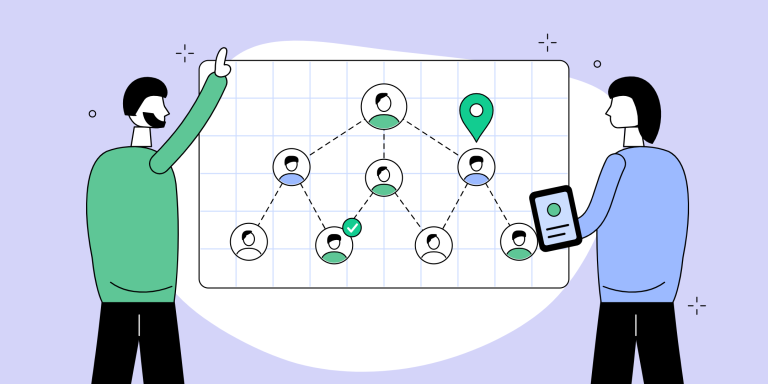
Talent mapping is the process of gaining a structured view of the capabilities and potential that already exist within an organization. It helps identify strengths, skills gaps, high-potential individuals, and training needs, and informs data-driven decisions about promotions or internal transfers rather than relying on intuition. When done well, it connects business strategy with what people can contribute.
Table of Contents
What is talent mapping?
It's a structured way to answer a question that concerns any HR manager: not so much whether the company has talent, but whether it has the right talent for what's coming and how to develop it. A talent map ceases to be a list of names on a spreadsheet when it compiles, using the same criteria for everyone, what skills each person has, at what level, and what potential they demonstrate.
The CIPD, the UK's professional human resources association, defines talent management as the systematic attraction, identification, development, engagement, retention and deployment of people valuable to the organization (CIPD, Talent managementTalent mapping is the identification piece: the diagnosis on which the others are based.
It is important not to confuse it with other similar tools:
| Tool | What are you looking at? | Horizon |
|---|---|---|
| Performance evaluation | Results and behaviors observed in a period | Recent past |
| Talent mapping | Available capabilities and potential versus needs | Present and future |
| Mapping the external market | Profiles and companies outside the organization | Future contracts |
Some sources use "talent mapping" for mapping the external market, a task typically associated with recruitment. This article focuses on internal mapping, which is used to develop, promote, and move people who are already within the company.
Why do it with data and not by intuition?
For years, talent development relied on hunches or highly subjective performance evaluations. Talent mapping functions as a scientific method because it uses comparable data to identify which competencies are truly linked to high performance in a specific context.
There is no single profile for universal success. What works for a tech company in Chile may not work for a distribution chain in Spain. That's why the map is built using data from the organization itself: it stops guessing and starts comparing against its own benchmark.
Furthermore, talent is not static. The report Future of Jobs 2025 by the World Economic Forum It estimates that, on average, the 39% of workers' skills will change or become outdated between 2025 and 2030. A map that was made once and stored in a drawer quickly loses value; it is more like a video that needs updating.
How do you do talent mapping step by step?
One approach that works well is to start with the people who already excel in each role and use their profile as a reference. This is the approach Hirint follows in his Talent Mapping, and can be summarized in seven steps:
- Define the objective and the critical positions. Do you want to plan for succession, guide training, or identify candidates for internal mobility? The objective determines which positions and what data are included in the analysis.
- Identify your top performers. Choose, using explicit criteria, the people with the best sustained performance in each critical position.
- Evaluate their skills with standardized tests. Measure soft skills and, where applicable, technical knowledge with reliable and valid instruments, the same for everyone.
- Look for the pattern. Is it resilience, assertive communication, or conceptual thinking? Identify the recurring skills and their level. This is the "DNA of success" for that position in your company.
- Build the ideal profile. It doesn't come from a generic manual, but from what already works in your culture and for your goals.
- Evaluate the rest of the staff using the same parameters. This way you can see how close or far each person is from the profile.
- Visualize the skill gap and decide. The discrepancy between each person's profile and their actual performance informs their training, promotion, and mobility. This assessment is repeated periodically.
Two important precautions. If the group of top performers is very small, the pattern may be a coincidence: compare it with other groups before making it the standard. And if the performance rating is biased, the profile will inherit that bias, so review the criteria you use to select the best performers beforehand.
How does the competency matrix fit into the map?
The competency matrix This is the clearest way to visualize the skills gap: it cross-references individuals and skills, indicating each skill level against the requirements of the position. A simple example, with levels 1 to 4 and an ideal profile in the first row:
| Person | Communication | Problem resolution | Leadership | Adaptability |
|---|---|---|---|---|
| Ideal job profile | 3 | 4 | 3 | 3 |
| Person A | 3 | 4 | 2 | 3 |
| Person B | 2 | 3 | 3 | 4 |
| Person C | 4 | 2 | 1 | 2 |
With this framework, the development conversation becomes clear: person A is close to the profile and only lacks leadership skills; person C needs a broader plan. Talent mapping allows us to tell each person the two or three skills that separate them from their next step, and that gives meaning to the training.
And the 9-box matrix?
The 9-box matrix It crosses two axes, performance and potential, at three levels each. Talent mapping provides evidence for the axis that is most difficult to measure, that of potential, which is often filled in based on the manager's impression.
| Potential / performance | Poor performance | Average performance | High performance |
|---|---|---|---|
| High potential | Enigma: Review fit and support | Growth potential | Future leader: preparing for succession |
| Average potential | Review expectations | Solid professional | High performance with margin |
| Low potential | Improvement plan | Stable contributor | Expert in his field |
Combining both tools avoids two common mistakes: promoting based solely on past results without considering the skills required for the new role, and labeling as "high potential" someone who is simply visible.
What is a talent map used for?
A talent map primarily applies to five decisions:
- Targeted training. Stop investing in generic courses and focus on the gaps that drive the business.
- Internal promotion and succession. Identifying who is ready for a critical position and what they lack is the basis of a good succession plan.
- internal mobility. Move talent from areas with less demand towards strategic projects and break down silos between departments.
- Anticipate changes. Identify those with the learning capacity to lead the adoption of new technologies.
- Managers who develop. Provide managers with reports that allow them to move from supervising tasks to supporting the development of their team's skills.
Common mistakes when doing talent mapping
- Treat it as a performance evaluation. Performance looks at past results; the map looks at future capabilities and needs. They complement each other.
- Do it only once. If the skills change, the map must change too.
- Copy a generic profile. The ideal profile comes from your organization, not from an internet list.
- Use a single source. Combine standardized tests with performance, 360 evaluation or interviews, and always decide with human judgment.
- Not explaining the process to people. Explain how the data is used and comply with the GDPR: provide clear information, limit the data to what is necessary, and consult with your data protection officer. AEPD guide on data protection in employment relationships It's a good starting point.
Frequently Asked Questions
What is talent mapping?
It is the process of obtaining a structured view of the capabilities and potential available within an organization. It gathers, using common criteria, what skills each person has and at what level, and compares them with the requirements of the positions. It serves to guide training, promotion, succession planning, and internal mobility with data.
What is the difference between talent mapping and performance evaluation?
Performance evaluation analyzes results or behaviors observed during a specific period. Talent mapping seeks a broader view of available capabilities and future needs. They complement each other: performance helps to select top performers who serve as benchmarks, and the map explains the skills behind that performance.
What data should a talent map include?
At a minimum, the relevant skills for each position, along with their level, the ideal benchmark profile, and each person's skill gap, should be included. This is usually supplemented with data on performance, potential, career interests, and risk of leaving. It's advisable to collect only what's necessary for the purpose of the skill map and to inform people how their data will be used.
How often should talent mapping be updated?
There is no single frequency. Many organizations review it annually or at the end of a training cycle, and update it sooner when the strategy changes, an area is reorganized, or a critical position is created. The important thing is to use the same tools for each measurement in order to be able to compare progress.
Is it possible to do talent mapping with psychometric tests?
Yes. Standardized assessments provide a structured and comparable source of information on skills and personality, which is combined with other talent data such as performance or 360-degree feedback. The tests must be validated for their intended use, and their results guide the decision without replacing the judgment of the responsible individuals.
If you want to discover which skills explain success in your key positions and how far each person is from achieving it, in Hirint We'll show you how Talent Mapping works with a case study from your company.